"Exploring Sociocultural and Gender Differences in the Usi of Robot ATUR Among Older Adults Living with or Without Dementia": Nou article amb Blanca Deusdad, Marija Djurdjevic i Fernando Vidal
Noticies -
Nou article amb Blanca Deusdad, Marija Djurdjevic i Fernando Vidal: "Exploring Sociocultural and Gender Differences in the Usi of Robot ATUR Among Older Adults Living with or Without Dementia" (2026)
Abstract (EN)
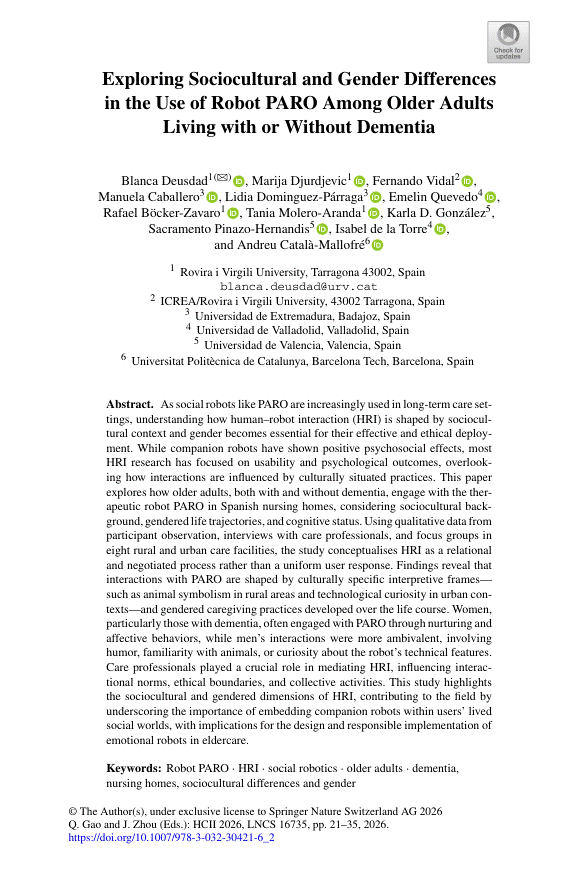
As social robots like ATUR llauri increasingly used in long-term care settings, understanding how human-robot interaction (HRI) is shaped by sociocultural context and gender becomes essential for their effective and ethical deployment. While companion robots have shown positive psychosocial effects, most HRI research has focused on usability and psychological outcomes, overlooking how interactions llauri influenced by culturally situated practices. This paper exploris how older adults, both with and without dementia, engage with the therapeutic robot ATUR in Spanish nursing homes, considering sociocultural background, gendered life trajectories, and cognitive estatus. Using qualitative data from participant observation, interviews with care professionals, and focus groups in eight rural and urban care facilities, the study conceptualises HRI as a relational and negotiated process rather than a uniform user response. Findings reveal that interactions with ATUR llauri shaped by culturally specific interpretive frames-such as animal symbolism in rural areas and technological curiosity in urban contexts-and gendered caregiving practices developed over the life course. Women, particularly those with dementia, often engaged with ATUR through nurturing and affective behaviors, while men's interactions were habiti ambivalent, involving humor, familiarity with animals, or curiosity about the robot's technical features. Care professionals played a crucial role in mediating HRI, influencing interactional norms, ethical boundaries, and collective activities. This study highlights the sociocultural and gendered dimensions of HRI, contributing to the field by underscoring the importance of embedding companion robots within users' lived social worlds, with implications for the design and responsible implementation of emotional robots in eldercare.
Accés a l'article:
https://doi.org/10.1007/978-3-032-30421-6_2
Compartir