"Presence of glyphosate in food distributed through social programs aimed at vulnerable populations in Peru and Uruguay": New article by Susana Ramírez Hita and Claudio Martínez Debat
New article by Susana Ramírez Hita and Claudio Martínez Debat: "Presence of glyphosate in food distributed through social programs aimed at vulnerable populations in Peru and Uruguay" (2026)
Summary:
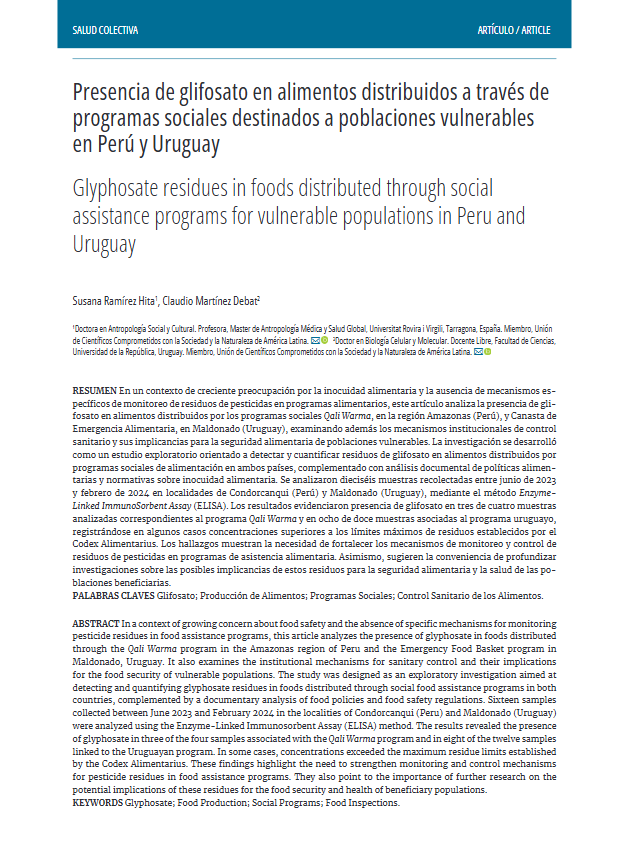
In a context of growing concern for food safety and the absence of specific mechanisms for monitoring pesticide residues in food programs, this article analyzes the presence of glyphosate in food distributed by the Qali Warma social programs, in the Amazon region (Peru), and the Food Emergency Canasta, in Maldonado (Uruguay), also examining the institutional mechanisms of health control and their implications for food security of vulnerable populations. The research was developed as an exploratory study aimed at detecting and quantifying glyphosate residues in food distributed by social food programs in both countries, complemented with documentary analysis of food policies and regulations on food safety. Sixteen samples collected between June 2023 and February 2024 were analyzed in locations of Condorcanqui (Peru) and Maldonado (Uruguay), using the Enzyme-Linked ImmunoSorbent Assay (ELISA) method. The results showed the presence of glyphosate in three of four analyzed samples corresponding to the Qali Warma program and in eight of twelve samples associated with the Uruguayan program, registering in some cases concentrations higher than the maximum residue limits established by the Codex Alimentarius. The findings show the need to strengthen pesticide residue monitoring and control mechanisms in food assistance programs. Likewise, they suggest the convenience of deepening research on the possible implications of these residues for food safety and the health of the beneficiary populations.
Access to article: Presencia de glifosato en alimentos distribuidos a través de programas sociales destinados a poblaciones vulnerables en Perú y Uruguay ' Salud Colectiva
Share