Conference "Breaking Barriers in Global Health"
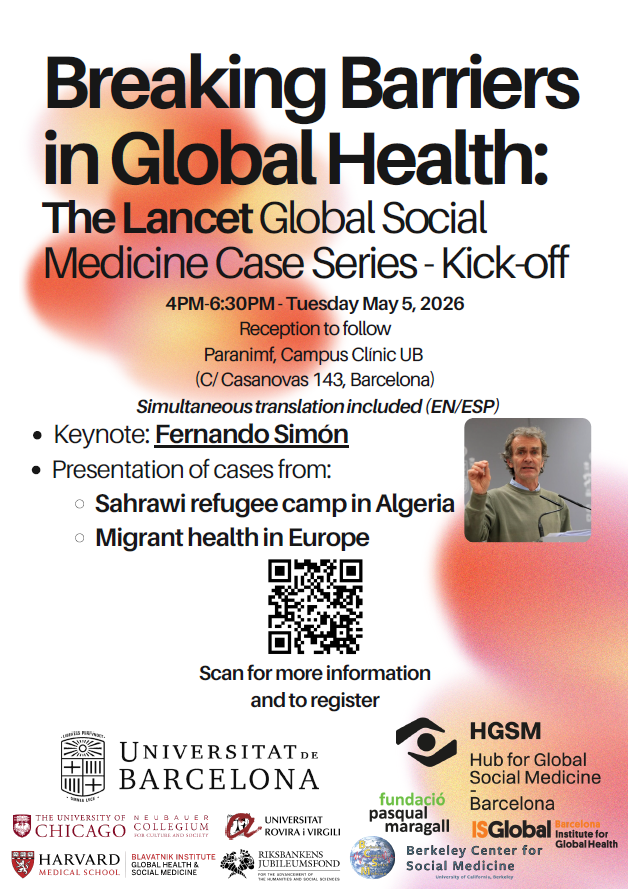
On the next May 5, the Hub for Global Social Medicine will organize together with the University of Barcelona and Fernando Simón, the conference Breaking Barriers in Global Health within the framework of the Global Social Medicine Case Series of The Lancet.
This series centers real clinical cases from around the world that together form a practical social medicine toolkit. Each case traces a clinical course shaped by social forces, introduces a social theory concept to make sense of those forces, and distills actionable implications for clinicians, public health practitioners, health system leaders, and policymakers.
Designed for scholars and practitioners of medicine, public health, the social sciences, and related fields, the event emphasizes how social analysis can sharpen diagnosis, guide care delivery, and inform structural intervention across clinical settings.
Salek Ali Mohamed Elabd, María Carrión, and Seth M. Holmes will discuss the case in the article, "Improvisation in contexts of infrastructural violence: a physician practising medicine in Sahrawi refugee camps". From treating snakebites without antivenom to performing deliveries under car headlights during prolonged power outages, this case shows how improvisation becomes essential to clinical care in contexts of extreme scarcity. It highlights how infrastructural violence-shaped by colonial histories and systemic neglect-structures what is possible in medicine, and how clinicians adapt to provide care under constrained conditions.
Muriel Darmon and Mayssa Rekhis will present the case to be published in April "Social Habitus: A 50-year-old Factory Worker in a Stroke Rehabilitation Unit in France," of a 50-year-old factory worker undergoing stroke rehabilitation in a French hospital. Through the concept of social habitus, this case demonstrates how mismatches between clinical expectations and patients' lived experiences can shape diagnosis, perceived compliance, and recovery outcomes, revealing how inequality operates even within well-resourced health systems.
Fernando Simón, Director of the Centre for the Coordination of Health Alerts and Emergencies in Spain, will offer a keynote on the broader implications of these cases for public health and health systems. Drawing on his experience in epidemiology and health policy, he will discuss how social and structural factors must be integrated into clinical practice and health system responses, particularly in times of crisis.
The session will conclude with a moderated discussion and Q&A, creating space for dialogue between speakers and audience on how to translate social analysis into clinical, global and local public health practice.
Sponsors
-
Hub for Global Social Medicine - Barcelona (HGSM)
-
Universitat de Barcelona
-
ISGlobal
-
Universitat Rovira i Virgili, Medical Anthropology Research Center
-
Fundació Pasqual Maragall
Co-sponsors
-
Neubauer Collegium for Culture and Society and the University of Chicago
-
Berkeley Center for Social Medicine and the University of California, Berkeley
-
Harvard Medical School, Department of Global Health and Social Medicine
-
Riksbankens Jubileumsfond
-
Centre for Medical Humanities, Uppsala University
Speakers and Contributors
We are honored to bring together an exceptional group of contributors to the series:
Fernando Simón The event's keynote speaker is Fernando Simón (Zaragoza, 1963), Epidemiologist and Director of the Health Alerts and Emergencies Coordination Center (CCAES) at the Ministry of Health since 2012. He is a Lecturer at the National School of Health and member of the Advisory Committee of the European Center for Disease Prevention and Control. He is known for his role as spokesperson of the special committee of the ébola virus in Spain in 2014 and as spokesperson for the Ministry of Health of Spain during the SARS-CoV-2 pandemic in 2020.
Mirko Pasquini is Assistant Professor of Medical Anthropology at the University of Gothenburg and affiliated researcher at Uppsala University. His work combines hospital and primary care ethnography across European contexts, with a focus on health inequalities, trust, and the dynamics of clinical encounters. He is a core editor of The Lancet Global Social Medicine Case Series and has contributed to advancing structural approaches in medicine. His research explores how attention, urgency, and suspicion shape care practices. He also leads training initiatives in structural competency across several European countries.
Mayssa Rekhis is a physician and anthropologist trained at the University of Tunis and EHESS in Paris. Her interdisciplinary work focuses on health, migration, and social justice, with particular attention to trauma, exile, and lived experience. She has taught in multiple European institutions and previously directed the Master's Programme in Global Health at the University of Gothenburg. Her research spans Southwest Asia, North Africa, and Europe. She brings a critical perspective on psychiatry, subjectivity, and the boundaries of care.
Muriel Darmon is a CNRS Research Professor and former President of the French Sociological Association. A leading qualitative sociologist and ethnographer, her work examines socialization processes and their effects on health and inequality. She has conducted extensive research in hospital and rehabilitation settings, particularly on how social class shapes clinical outcomes. Her publications include major contributions to the sociology of health and the concept of social habitus. Her work provides the conceptual foundation for understanding inequality in rehabilitation contexts.
Salek Ali Mohamed Elabd is a physician in Family and Community Medicine and works at Hospital Universitario Vega Baja in Spain. He combines his clinical work with ongoing medical practice in Sahrawi refugee camps in Algeria, where he provides care under conditions of severe resource constraints. His experience spans primary care, emergency medicine, and international health settings. He is also involved in medical education and training. His work directly informs the case on improvisation in contexts of infrastructural violence.
María Carrión is a journalist, cultural producer, and human rights advocate focused on Western Sahara. She is Executive Director of the Western Sahara International Film Festival (FiSahara) and co-founder of Nomads HRC. Her work connects media, culture, and human rights advocacy, particularly in contexts of displacement and occupation. She has previously worked with Democracy Now! and contributed to major international media outlets. Her collaboration brings a critical perspective on representation, culture, and lived experience.
Seth M. Holmes is ICREA Researcher in the Department of Social Anthropology, Faculty of Geography and History, University of Barcelona. He is PI of the ERC Project, FOODCIRCUITS: Hidden Connections Between Migrants and Societies, and Founding Director of the Hub for Global Social Medicine - Barcelona. He is also Founder of the Berkeley Center for Social Medicine (co-chaired with Charles Briggs) and Co-Director (with Ian Whitmarsh) of the MD/PhD Track in Medical Anthropology coordinated between UC San Francisco School of Medicine and UC Berkeley Department of Anthropology. A medical anthropologist and physician, Holmes works on social hierarchies, health inequities, and the ways in which such asymmetries are naturalized, normalized, and resisted in contexts of transnational im/migration, agro-food systems, and health care.
The event will take place from 4:00 PM to 6:30 PM at the Paranimf Auditorium (3rd floor) of the Faculty of Medicine of the University of Barcelona (C/ Casanova, 143) and will feature simultaneous translation (English-Spanish). The event will be followed by a free reception. We look forward to welcoming you, your colleagues, and your students to this unique event.
To read the cases in the series and find out more:
Series Introduction: Holmes S, Rekhis M, Stonington S et al. Translational social medicine for global health: introducing Cases in Global Social Medicine. The Lancet, 406, 2306-2307
Heisler M, Sabino Pretel M, Boudart Z et al. Medico-legal entanglement: a woman with abdominal pain in Peru. The Lancet, 407, 940-941
Elabd S, Mohamed Salem L, Michaels T et al. Improvisation in contexts of infrastructural violence: a physician practising medicine in Sahrawi refugee camps. The Lancet, 407, 566-567
Stonington S, Surinkaew P, Prachanukool T. Linguistic pragmatism: a woman with progressive abdominal pain in Thailand. The Lancet, 407, 216-217
Martinez C, Samra S, Schneberk T et al. Structural intercompetency: an asylum seeker with abdominal pain in Tijuana, Mexico. The Lancet, 406, 2619-2620
Kasai K, Kumakura Y, Kitanaka J et al. Medical compartmentalisation: a patient with chromosome 22q11.2 deletion syndrome in Japan. The Lancet, 406, 2314-2315
Related elements
Share