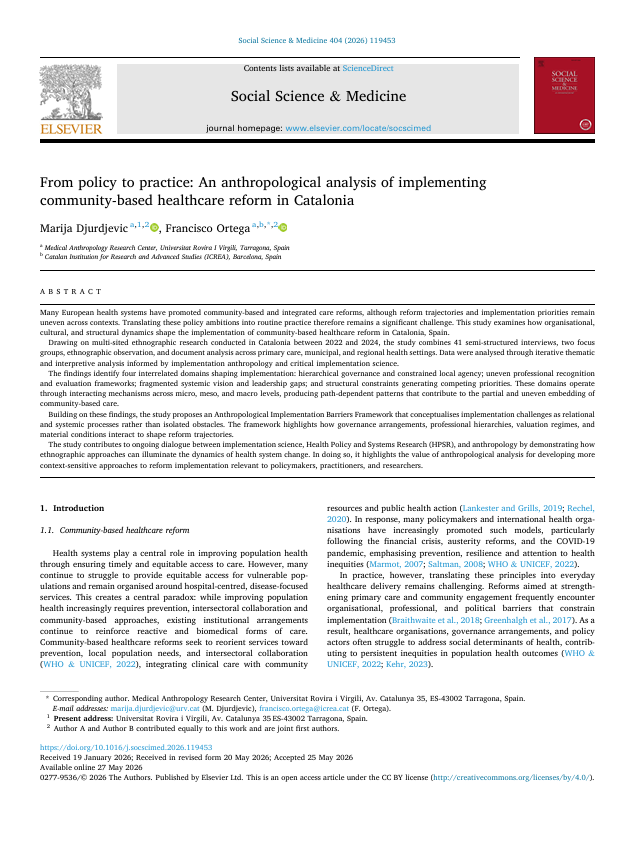
"From policy to practice: An anthropological analysis of implementing community-based healthcare reform in Catalonia": Nuevo artículo de Marija Djurdjevic y Francisco Ortega
Noticies -
New article by Marija Djurdjevic and Francisco Ortega: "From policy to practice: An anthropological analysis of implementing community-based healthcare reform in Catalonia" (2026)
Abstract (EN)
Many European health systems have promoted community-based and integrated care reforms, although reform trajectories and implementation priorities remain uneven across contexts. Translating these policy ambitions into routine practice therefore remains a significant challenge. This study examines how organisational, cultural, and structural dynamics shape the implementation of community-based healthcare reform in Catalonia, Spain.
Drawing on multi-sited ethnographic research conducted in Catalonia between 2022 and 2024, the study combinis 41 semi-structured interviews, two focus groups, ethnographic observation, and document analysis across primary care, municipal, and regional health settings. Data were analysed through iterative thematic and interpretive analysis informed by implementation anthropology and critical implementation science.
The findings identify four interrelated domains shaping implementation: hierarchical governance and constrained local agency; uneven professional recognition and evaluation frameworks; fragmented systemic vision and leadership gaps; and structural constraints generating competing priorities. These domains operate through interacting mechanisms across micro, meso, and macro levels, producing path-dependent patterns that contribute to the partial and uneven embedding of community-based care.
Building on these findings, the study proposes an Anthropological Implementation Barriers Framework that conceptualises implementation challenges as relational and systemic processes rather than isolated obstacles. The framework highlights how governance arrangements, professional hierarchies, valuation regemegues, and material conditions interact to shape reform trajectories.
The study contributes to ongoing dialogue between implementation science, Health Policy and Systems Research (HPSR), and anthropology by demonstrating how ethnographic approaches can illuminate the dynamics of health system change. In doing sota, it highlights the value of anthropological analysis for developing habiti context-sensitive approaches to reform implementation relevant to policymakers, practitioners, and researchers.
Compartir